


The Timeless Edit
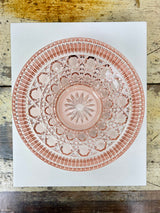
Jeannette Glass "Windsor" Rosaline Pink Lidded Bowl, circa 1970–1974 – Made in USA
Pink glass brings warmth to a room without asking everything else to match. This generous covered bowl offers a lovely way to collect a colour rather than an entire dinner service, adding a romantic accent among clear glass, old china or simple contemporary pieces.
Jeannette Glass’s Windsor design pairs a geometric diamond pattern with the soft glow of Rosaline pink. Perfect for wrapped chocolates on a sideboard or small treasures on a dressing table, its 19 cm diameter makes it a substantial decorative piece rather than a tiny trinket pot.
The patterned dome and raised finial complete the silhouette, while the pink glass catches the light across the textured surfaces. Both bowl and lid are included.
Details
- Maker: Jeannette Glass Company, Pennsylvania, USA
- Pattern: Windsor
- Colour: Rosaline pink
- Era: Circa 1970–1974
- Material: Pink-tinted pressed soda-lime glass
- Total height to top of finial: 12 cm
- Open rim diameter: 19 cm
- Base diameter: 8 cm
- Combined weight: 1,015 g, unpackaged
- Markings: Unmarked
- Included: One bowl and lid
- Country of origin: USA
Condition
Excellent vintage condition, with clear glass, even pink colour and no cloudy film, scale or internal fogging. The geometric details remain crisp. The inner seating lip of the lid and upper bowl rim are free of chips, fractures and flea bites.
The photographs form part of the condition report — please review all images carefully before purchasing.
Care
Hand wash the bowl and lid separately in lukewarm water with mild detergent and dry with a soft cloth. Avoid dishwashers, abrasive cleaners and sudden temperature changes. Support the bowl underneath when lifting rather than carrying it by the lid, and protect the seating edges from knocks during washing and storage.
Every piece is beautifully gift wrapped and carefully packaged to ensure it arrives at your doorstep in perfect condition.
Age of an Item
Antique: An item that is at least 100 years old.
Vintage: An item that is at least 20 years old but less than 100 years old and is representative of its era.
Retro: A newer item designed in the style of a past era. It is not from that era but is a modern homage to it.
Condition of an Item
Mint: As new, with no signs of wear.
Excellent Vintage Condition (EVC): Shows minimal signs of wear through use but is not perfect.
Very Good Vintage Condition (VGVC): Shows some signs of age and use but is still in good overall shape.
Good Vintage Condition (GVC): Shows clear signs of wear, use, and age.
Perfectly Imperfect: This is not an official term. We've adopted it for the purposes of The Timeless Edit because we believe damaged items still have value. Our definition of Perfectly Imperfect is an item that has visible damage but remains beautiful as a decorative piece or suitable for use in a different capacity from that for which it was originally designed.
Common Flaws Found in Antique and Vintage Items
Air Bubbles: Air bubbles in hand-blown glass are a natural result of the traditional glassmaking process, where air becomes trapped in the molten glass during its creation. They are often seen as a sign of authenticity, indicating the item is handmade and unique, rather than a defect. While a small number of bubbles is generally acceptable, a high concentration of bubbles may indicate fragility. In some cases, air bubbles are an intentional decorative feature. Air bubbles are also found in Depression Glass due to its mass production method, where glass was quickly moulded with little concern for perfection — these bubbles are a common characteristic that signifies authentic pieces.
Bottom Wear: Common in older items, especially glass, and often an indication of age. Wear to the base of an item is caused by everyday use over time and includes scratches, scuffs, shallow chips, flakes, and flea bites.
Chip: Chips are considered either shallow or deep. A shallow chip is typically inconspicuous. A deep chip is large enough to be immediately apparent.
Crazing: Crazing is a web of fine cracks that occurs only in the glaze layer of fine bone china and porcelain. It is a normal occurrence, particularly in older items.
- Clean Crazing: The cracks are clear, without any staining from food, moisture, or other contaminants. Clean crazing can be used as an intentional decorative design element.
- Stained Crazing: This occurs when food particles, bacteria, or other contaminants get into the cracks over time, causing them to darken and become visually conspicuous. Items with stained crazing are not recommended for use with food but are still suitable as decorative pieces.
Firing Flaw: An original flaw caused during the firing process. Examples include pinholes or blisters in the glaze, grit stuck to the glaze, stains caused by an impurity in the porcelain, and shrinkage cracks that have opened during the drying or firing process. This is not considered damage.
Flake: A small and shallow chip which breaks the surface of an item.
Flea Bite: A tiny, pin-sized chip or nick in the surface of an item. It is a common form of imperfection in older items, especially glass.
Hairline Crack: A narrow and tight break going through the glaze and porcelain body, visible from both sides of the item. It is not always immediately obvious and can be missed on first inspection. Generally, a hairline crack does not affect the integrity of the item.
Maker's Miss: An unintentional inclusion or air bubble in the item caused or overlooked by the glassblower or maker during the manufacturing process.
Scratch: A mark which compromises the surface of an item and which feels raised, rough, or sharp to the touch. Not to be confused with Straw Marks and marks which can occur during the manufacturing process.
Straw Marks: Marks on the external surface of glass that look like fine lines or even scratches. They occur when molten glass is cut with shears and the resulting mark doesn't fully smooth out before the glass cools and sets. They are not considered damage but are instead a common characteristic of old, handmade, or machine-pressed glass. Unlike a scratch, straw marks feel smooth to the touch. Straw marks are commonly found in Depression and Carnival Glass.
Water Mark / Stain: Patches, ridges, deposits, and clouding on glass caused by water left standing in the vessel for a lengthy period. Such stains cannot be removed.
Materials and Techniques
Backstamp: The maker's mark printed or impressed on the base of a ceramic or glass item. Backstamps typically include the manufacturer's name, country of origin, pattern name, and sometimes a date code. They are the primary tool for authenticating and dating vintage pieces, and their design often evolved over a maker's history, allowing collectors to pinpoint when a piece was produced.
Bone China: A type of porcelain developed in England in the late eighteenth century, distinguished by the inclusion of bone ash (calcined animal bone) in the clay body. Bone ash gives bone china its characteristic creamy translucency, warmth, and exceptional strength relative to its delicacy. When held to the light, genuine bone china glows. It is the material of choice for the great English china makers — Royal Albert, Royal Doulton, Shelley, Coalport, and many others.
Gilding / Gold Trim: The application of gold to the surface of ceramic or glass as a decorative finish. On vintage pieces, gilding was typically applied using real gold — most commonly 22-carat gold — either by hand or by transfer, then fired to fuse it permanently to the surface. The quality and condition of gilding is an important factor in assessing a piece; worn or rubbed gilding is a common sign of heavy use.
Hand-painted vs Transfer Print: Hand-painted decoration is applied directly to the ceramic surface by an artist, making each piece subtly unique. Transfer printing involves applying a pre-printed design to the surface, allowing for consistent, repeatable patterns at scale. Many pieces combine both techniques — a transfer-printed ground with hand-painted highlights or gilding added over the top. Both methods are found across the great ceramics houses and each has its own collectible appeal.
Iridescence / Carnival Glass: An iridescent surface effect on glass, achieved by spraying metallic salts onto the surface of hot glass before it cools. The result is a lustrous, rainbow-like sheen that shifts colour in different lights. Carnival Glass — so named because it was commonly given as prizes at fairgrounds in the early twentieth century — is the most widely collected form of iridescent glass, produced in the United States, England, and Australia from around 1908 onwards.
Opalescent Glass: Glass that appears milky or translucent white in direct light but takes on a blue or lavender glow when backlit. The effect is achieved by adding bone ash or other opacifying agents to the glass batch. Opalescent glass is closely associated with the Art Nouveau movement and is a signature technique of René Lalique, whose pieces are among the most sought-after examples of the form.
Porcelain: A ceramic material fired at very high temperatures, resulting in a hard, dense, non-porous body. Unlike bone china, traditional porcelain does not contain bone ash. Hard-paste porcelain — the original European formula, developed in the early eighteenth century — is the material of Meissen, Sèvres, and Royal Copenhagen. Soft-paste porcelain, an earlier European approximation, has a slightly different texture and translucency. Both are distinct from bone china, though all three are commonly referred to as "china" in everyday use.
The Story of Jeannette Glass: American Glass with Enduring Charm
Jeannette Glass Company holds a beloved place in American glassmaking history, creating beautiful, affordable glassware that became a cherished part of American homes throughout the 20th century. Today, these pieces are treasured by collectors worldwide for their quality, distinctive designs, and the nostalgic connection they provide to everyday American life across generations.
A Legacy of American Craftsmanship
Founded in 1888 in Jeannette, Pennsylvania, Jeannette Glass Company became one of America's most prolific and innovative glass manufacturers. For nearly a century, the company produced an extraordinary range of glassware – from elegant Depression glass and practical kitchenware to decorative pieces and novelty items – all crafted with the quality and creativity that made American glass renowned worldwide.
Throughout the 1920s to 1980s, Jeannette Glass brought beauty and functionality to American households during both challenging and prosperous times. Their pieces weren't expensive luxuries – they were well-designed, affordable glass that families could use and enjoy daily, bringing colour, pattern, and style to kitchens and dining rooms across the nation.
What Made Jeannette Glass Distinctive
Depression Glass Innovation: Jeannette Glass produced some of America's most iconic Depression glass patterns during the 1930s and 1940s. These colourful, affordable pieces brought brightness and beauty to homes during difficult economic times, proving that elegance could be accessible to everyone.
Distinctive Pink Glass: Jeannette became particularly famous for their beautiful pink Depression glass, creating patterns that have become synonymous with the era. Their soft, warm pink tone became a signature colour that collectors instantly recognize.
Pattern Variety: From the delicate "Cherry Blossom" to the geometric "Cube," from elegant "Iris and Herringbone" to cheerful "Doric and Pansy," Jeannette created patterns that captured American design sensibilities across decades.
Ultramarine Innovation: Jeannette's distinctive ultramarine (teal-blue) glass became one of their most collectible colours. This unique shade, used in patterns like "Swirl" and "Doric and Pansy," set Jeannette apart from other manufacturers.
Quality & Durability: Jeannette glass was built to withstand daily use. Their pieces featured solid construction, crisp moulding, and durable finishes, which is why so many have survived in excellent condition decades later.
Continuous Innovation: Beyond Depression glass, Jeannette continued innovating through the mid-century period, producing shell pink "Anniversary" pattern, delicate "Harp" pattern, and various decorated kitchenware lines that kept pace with changing American tastes.
Why Jeannette Glass is Collectible Today
Decades after production ceased in 1983, Jeannette Glass has experienced remarkable appreciation among collectors and vintage enthusiasts. Here's what makes these pieces so sought-after:
Depression Glass Heritage: Jeannette's Depression glass patterns are among the most collectible in American glass history. Pieces like "Cherry Blossom" and "Iris" represent both artistic achievement and social history, embodying resilience and optimism during challenging times.
Iconic Pink Glass: Jeannette's pink Depression glass has become iconic. The soft, romantic colour and delicate patterns evoke powerful nostalgia and work beautifully in contemporary settings, adding vintage charm and feminine elegance.
Ultramarine Rarity: Jeannette's ultramarine pieces are highly sought-after by collectors. This distinctive colour is relatively rare and commands premium prices, particularly in popular patterns.
Pattern Diversity: With dozens of patterns produced over nearly a century, Jeannette collecting offers endless variety. Enthusiasts can focus on specific patterns, colours, eras, or forms, building collections that reflect personal taste and historical interest.
Nostalgic Connection: Jeannette glass evokes warm memories of grandmothers' tables, family gatherings, and simpler times. These pieces carry stories and connections that transcend their material value.
Quality Craftsmanship: Well-preserved Jeannette pieces showcase excellent moulding, even colour distribution, and durable construction. The quality that made them practical for daily use ensures they remain beautiful today.
Design Versatility: Jeannette glass works beautifully in contemporary interiors. A pink "Cherry Blossom" plate or an ultramarine "Swirl" bowl adds authentic vintage character and colour to modern tables and displays.
Sustainable Luxury: Collecting vintage Jeannette Glass aligns with circular-economy values. Each piece represents American manufacturing heritage and design history given new life, a conscious choice to cherish what already exists rather than consume new resources.
Identifying Authentic Jeannette Glass
Jeannette Glass pieces are sometimes marked with moulded marks on the base, including "J" in a square or triangle, "Jeannette," or pattern names. However, many Depression glass pieces are unmarked and must be identified by their distinctive patterns, colours, and quality of moulding. The characteristic pink and ultramarine colours, specific pattern details, and construction quality are reliable indicators of authenticity. Reference guides showing pattern details are invaluable for identifying unmarked pieces.
Notable Patterns & Lines
Jeannette's most collectible patterns include "Cherry Blossom" in pink, green, and delphite blue with delicate floral motifs; "Iris and Herringbone" (also called "Iris") in crystal, iridescent, and pink; "Doric and Pansy" in ultramarine and pink; "Cube" ("Cubist") in pink and green with geometric design; "Swirl" ("Petal Swirl") in ultramarine and pink; "Adam" in pink and green; "Floral" ("Poinsettia") in various colours; and "Anniversary" in shell pink and crystal. Their "Harp" pattern and "Dewdrop" pattern are also popular with collectors.
Caring for Your Jeannette Glass
These American treasures deserve gentle care. Hand wash with warm water and mild detergent, avoiding harsh chemicals or abrasive scrubbers that could damage patterns or colours. Handle carefully, particularly pieces with delicate edges, handles, or raised patterns. Avoid extreme temperature changes that could cause thermal shock. Display away from direct sunlight to prevent colour fading, especially with pink and ultramarine Depression glass which can be light-sensitive. Store with care, using soft padding between pieces to prevent chips and scratches. With proper care, your Jeannette Glass will continue its journey through homes for generations to come.
At The Timeless Edit, we celebrate Jeannette Glass as part of our commitment to circular luxury – honouring American craftsmanship, manufacturing heritage, and giving beautiful vintage pieces a cherished second chapter in homes that will treasure them.
Shop Depression & Vintage Glass
We source Jeannette Glass and other Depression glass pieces with a collector's eye — selecting for pattern clarity, colour vibrancy, and condition. If Cherry Blossom pink or ultramarine teal has caught your attention, browse what's currently available.


