


The Christmas Shop
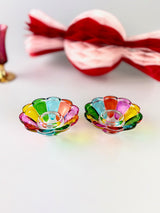
DueZeta Venetian Glass Candle Holders, Pair — Italian Art Glass
Italy has been making extraordinary glass for centuries, and Venetian glasswork — with its swirled colours, its weight, its particular way of holding and throwing light — is among the most recognisable in the world. This pair of candle holders is a beautiful example of that tradition.
Made by DueZeta, an Italian glassware manufacturer, each holder features the swirled glass technique that defines Venetian artistry — rich colours moving through the glass in a way that shifts with the light and comes fully alive when a candle is lit. The original DueZeta sticker remains on the base of each piece, confirming their provenance. They're a pair, but not identical in the way mass-produced pieces are — there's the small, pleasing variation that comes from something made by hand. On a Christmas table they're quietly spectacular. Year-round, they're simply beautiful objects to live with. A considered addition to a home that values craft — or a significant gift for someone who appreciates Italian glass.
Both pieces are in excellent vintage condition.
Details
- Maker: DueZeta, Italy
- Style: Venetian hand-crafted swirled art glass
- Material: Hand-crafted glass
- Authentication: Original DueZeta sticker to base
- Set includes: 2 candle holders
- Weight: approximately 500g for the pair
Condition
Excellent vintage condition. No chips, cracks, or damage to either piece. Glass is clear and bright. Original maker's stickers intact.
Care
Hand wash only in warm water with mild detergent. Avoid thermal shock — do not pour boiling water into the holders. Dry immediately with a soft lint-free cloth.
Postage
Free tracked domestic shipping with full insurance. This pair is double-boxed and packed with professional-grade materials to ensure both pieces arrive in perfect condition.
Age of an Item
Antique: An item that is at least 100 years old.
Vintage: An item that is at least 20 years old but less than 100 years old and is representative of its era.
Retro: A newer item designed in the style of a past era. It is not from that era but is a modern homage to it.
Condition of an Item
Mint: As new, with no signs of wear.
Excellent Vintage Condition (EVC): Shows minimal signs of wear through use but is not perfect.
Very Good Vintage Condition (VGVC): Shows some signs of age and use but is still in good overall shape.
Good Vintage Condition (GVC): Shows clear signs of wear, use, and age.
Perfectly Imperfect: This is not an official term. We've adopted it for the purposes of The Timeless Edit because we believe damaged items still have value. Our definition of Perfectly Imperfect is an item that has visible damage but remains beautiful as a decorative piece or suitable for use in a different capacity from that for which it was originally designed.
Common Flaws Found in Antique and Vintage Items
Air Bubbles: Air bubbles in hand-blown glass are a natural result of the traditional glassmaking process, where air becomes trapped in the molten glass during its creation. They are often seen as a sign of authenticity, indicating the item is handmade and unique, rather than a defect. While a small number of bubbles is generally acceptable, a high concentration of bubbles may indicate fragility. In some cases, air bubbles are an intentional decorative feature. Air bubbles are also found in Depression Glass due to its mass production method, where glass was quickly moulded with little concern for perfection — these bubbles are a common characteristic that signifies authentic pieces.
Bottom Wear: Common in older items, especially glass, and often an indication of age. Wear to the base of an item is caused by everyday use over time and includes scratches, scuffs, shallow chips, flakes, and flea bites.
Chip: Chips are considered either shallow or deep. A shallow chip is typically inconspicuous. A deep chip is large enough to be immediately apparent.
Crazing: Crazing is a web of fine cracks that occurs only in the glaze layer of fine bone china and porcelain. It is a normal occurrence, particularly in older items.
- Clean Crazing: The cracks are clear, without any staining from food, moisture, or other contaminants. Clean crazing can be used as an intentional decorative design element.
- Stained Crazing: This occurs when food particles, bacteria, or other contaminants get into the cracks over time, causing them to darken and become visually conspicuous. Items with stained crazing are not recommended for use with food but are still suitable as decorative pieces.
Firing Flaw: An original flaw caused during the firing process. Examples include pinholes or blisters in the glaze, grit stuck to the glaze, stains caused by an impurity in the porcelain, and shrinkage cracks that have opened during the drying or firing process. This is not considered damage.
Flake: A small and shallow chip which breaks the surface of an item.
Flea Bite: A tiny, pin-sized chip or nick in the surface of an item. It is a common form of imperfection in older items, especially glass.
Hairline Crack: A narrow and tight break going through the glaze and porcelain body, visible from both sides of the item. It is not always immediately obvious and can be missed on first inspection. Generally, a hairline crack does not affect the integrity of the item.
Maker's Miss: An unintentional inclusion or air bubble in the item caused or overlooked by the glassblower or maker during the manufacturing process.
Scratch: A mark which compromises the surface of an item and which feels raised, rough, or sharp to the touch. Not to be confused with Straw Marks and marks which can occur during the manufacturing process.
Straw Marks: Marks on the external surface of glass that look like fine lines or even scratches. They occur when molten glass is cut with shears and the resulting mark doesn't fully smooth out before the glass cools and sets. They are not considered damage but are instead a common characteristic of old, handmade, or machine-pressed glass. Unlike a scratch, straw marks feel smooth to the touch. Straw marks are commonly found in Depression and Carnival Glass.
Water Mark / Stain: Patches, ridges, deposits, and clouding on glass caused by water left standing in the vessel for a lengthy period. Such stains cannot be removed.
Materials and Techniques
Backstamp: The maker's mark printed or impressed on the base of a ceramic or glass item. Backstamps typically include the manufacturer's name, country of origin, pattern name, and sometimes a date code. They are the primary tool for authenticating and dating vintage pieces, and their design often evolved over a maker's history, allowing collectors to pinpoint when a piece was produced.
Bone China: A type of porcelain developed in England in the late eighteenth century, distinguished by the inclusion of bone ash (calcined animal bone) in the clay body. Bone ash gives bone china its characteristic creamy translucency, warmth, and exceptional strength relative to its delicacy. When held to the light, genuine bone china glows. It is the material of choice for the great English china makers — Royal Albert, Royal Doulton, Shelley, Coalport, and many others.
Gilding / Gold Trim: The application of gold to the surface of ceramic or glass as a decorative finish. On vintage pieces, gilding was typically applied using real gold — most commonly 22-carat gold — either by hand or by transfer, then fired to fuse it permanently to the surface. The quality and condition of gilding is an important factor in assessing a piece; worn or rubbed gilding is a common sign of heavy use.
Hand-painted vs Transfer Print: Hand-painted decoration is applied directly to the ceramic surface by an artist, making each piece subtly unique. Transfer printing involves applying a pre-printed design to the surface, allowing for consistent, repeatable patterns at scale. Many pieces combine both techniques — a transfer-printed ground with hand-painted highlights or gilding added over the top. Both methods are found across the great ceramics houses and each has its own collectible appeal.
Iridescence / Carnival Glass: An iridescent surface effect on glass, achieved by spraying metallic salts onto the surface of hot glass before it cools. The result is a lustrous, rainbow-like sheen that shifts colour in different lights. Carnival Glass — so named because it was commonly given as prizes at fairgrounds in the early twentieth century — is the most widely collected form of iridescent glass, produced in the United States, England, and Australia from around 1908 onwards.
Opalescent Glass: Glass that appears milky or translucent white in direct light but takes on a blue or lavender glow when backlit. The effect is achieved by adding bone ash or other opacifying agents to the glass batch. Opalescent glass is closely associated with the Art Nouveau movement and is a signature technique of René Lalique, whose pieces are among the most sought-after examples of the form.
Porcelain: A ceramic material fired at very high temperatures, resulting in a hard, dense, non-porous body. Unlike bone china, traditional porcelain does not contain bone ash. Hard-paste porcelain — the original European formula, developed in the early eighteenth century — is the material of Meissen, Sèvres, and Royal Copenhagen. Soft-paste porcelain, an earlier European approximation, has a slightly different texture and translucency. Both are distinct from bone china, though all three are commonly referred to as "china" in everyday use.


