


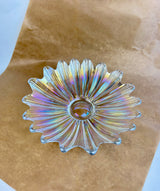
Starburst glass was made for a little theatre. This three-piece Federal Glass set catches the light with its bold radiating pattern, bringing the optimistic geometry of 1970s American design to the table without losing its everyday usefulness.
Made by the Federal Glass Company in the United States, the set features three coordinating pieces from the Celestial range, each with a different shape and size. The pressed-glass pattern creates movement across every surface, while the varied forms make the set useful for serving, entertaining or styling as a group. It is perfect for presenting snacks, desserts and appetisers, or for adding a retro note to a sideboard or open shelf.
Used together, the three pieces make a cohesive vintage serving collection. Used separately, they bring a quietly graphic touch to different corners of the home — a good example of why well-designed vintage tableware need not be saved for special occasions.
Details
- Maker: Federal Glass Company
- Pattern: Celestial, also known as Starburst
- Era: 1970s
- Style: Mid-century modern / retro
- Material: Pressed glass
- Set includes: Three coordinating serving pieces in different shapes and sizes
- Combined weight: 2,540g
- Country of Origin: United States — Made in USA
Condition
Excellent vintage condition. There are no chips, cracks or restoration, with minimal signs of use consistent with age. The glass remains clear and the starburst decoration is well preserved.
The photographs form part of the condition report — please review all images carefully before purchasing.
Care
Hand wash only with mild soap and warm water. Avoid harsh or abrasive cleaners and sudden changes in temperature. Not suitable for the dishwasher or microwave. Dry immediately with a soft, lint-free cloth to help prevent water spots.
Every piece is carefully wrapped and packaged to ensure it arrives at your doorstep in perfect condition.
Age of an Item
Antique: An item that is at least 100 years old.
Vintage: An item that is at least 20 years old but less than 100 years old and is representative of its era.
Retro: A newer item designed in the style of a past era. It is not from that era but is a modern homage to it.
Condition of an Item
Mint: As new, with no signs of wear.
Excellent Vintage Condition (EVC): Shows minimal signs of wear through use but is not perfect.
Very Good Vintage Condition (VGVC): Shows some signs of age and use but is still in good overall shape.
Good Vintage Condition (GVC): Shows clear signs of wear, use, and age.
Perfectly Imperfect: This is not an official term. We've adopted it for the purposes of The Timeless Edit because we believe damaged items still have value. Our definition of Perfectly Imperfect is an item that has visible damage but remains beautiful as a decorative piece or suitable for use in a different capacity from that for which it was originally designed.
Common Flaws Found in Antique and Vintage Items
Air Bubbles: Air bubbles in hand-blown glass are a natural result of the traditional glassmaking process, where air becomes trapped in the molten glass during its creation. They are often seen as a sign of authenticity, indicating the item is handmade and unique, rather than a defect. While a small number of bubbles is generally acceptable, a high concentration of bubbles may indicate fragility. In some cases, air bubbles are an intentional decorative feature. Air bubbles are also found in Depression Glass due to its mass production method, where glass was quickly moulded with little concern for perfection — these bubbles are a common characteristic that signifies authentic pieces.
Bottom Wear: Common in older items, especially glass, and often an indication of age. Wear to the base of an item is caused by everyday use over time and includes scratches, scuffs, shallow chips, flakes, and flea bites.
Chip: Chips are considered either shallow or deep. A shallow chip is typically inconspicuous. A deep chip is large enough to be immediately apparent.
Crazing: Crazing is a web of fine cracks that occurs only in the glaze layer of fine bone china and porcelain. It is a normal occurrence, particularly in older items.
- Clean Crazing: The cracks are clear, without any staining from food, moisture, or other contaminants. Clean crazing can be used as an intentional decorative design element.
- Stained Crazing: This occurs when food particles, bacteria, or other contaminants get into the cracks over time, causing them to darken and become visually conspicuous. Items with stained crazing are not recommended for use with food but are still suitable as decorative pieces.
Firing Flaw: An original flaw caused during the firing process. Examples include pinholes or blisters in the glaze, grit stuck to the glaze, stains caused by an impurity in the porcelain, and shrinkage cracks that have opened during the drying or firing process. This is not considered damage.
Flake: A small and shallow chip which breaks the surface of an item.
Flea Bite: A tiny, pin-sized chip or nick in the surface of an item. It is a common form of imperfection in older items, especially glass.
Hairline Crack: A narrow and tight break going through the glaze and porcelain body, visible from both sides of the item. It is not always immediately obvious and can be missed on first inspection. Generally, a hairline crack does not affect the integrity of the item.
Maker's Miss: An unintentional inclusion or air bubble in the item caused or overlooked by the glassblower or maker during the manufacturing process.
Scratch: A mark which compromises the surface of an item and which feels raised, rough, or sharp to the touch. Not to be confused with Straw Marks and marks which can occur during the manufacturing process.
Straw Marks: Marks on the external surface of glass that look like fine lines or even scratches. They occur when molten glass is cut with shears and the resulting mark doesn't fully smooth out before the glass cools and sets. They are not considered damage but are instead a common characteristic of old, handmade, or machine-pressed glass. Unlike a scratch, straw marks feel smooth to the touch. Straw marks are commonly found in Depression and Carnival Glass.
Water Mark / Stain: Patches, ridges, deposits, and clouding on glass caused by water left standing in the vessel for a lengthy period. Such stains cannot be removed.
Materials and Techniques
Backstamp: The maker's mark printed or impressed on the base of a ceramic or glass item. Backstamps typically include the manufacturer's name, country of origin, pattern name, and sometimes a date code. They are the primary tool for authenticating and dating vintage pieces, and their design often evolved over a maker's history, allowing collectors to pinpoint when a piece was produced.
Bone China: A type of porcelain developed in England in the late eighteenth century, distinguished by the inclusion of bone ash (calcined animal bone) in the clay body. Bone ash gives bone china its characteristic creamy translucency, warmth, and exceptional strength relative to its delicacy. When held to the light, genuine bone china glows. It is the material of choice for the great English china makers — Royal Albert, Royal Doulton, Shelley, Coalport, and many others.
Gilding / Gold Trim: The application of gold to the surface of ceramic or glass as a decorative finish. On vintage pieces, gilding was typically applied using real gold — most commonly 22-carat gold — either by hand or by transfer, then fired to fuse it permanently to the surface. The quality and condition of gilding is an important factor in assessing a piece; worn or rubbed gilding is a common sign of heavy use.
Hand-painted vs Transfer Print: Hand-painted decoration is applied directly to the ceramic surface by an artist, making each piece subtly unique. Transfer printing involves applying a pre-printed design to the surface, allowing for consistent, repeatable patterns at scale. Many pieces combine both techniques — a transfer-printed ground with hand-painted highlights or gilding added over the top. Both methods are found across the great ceramics houses and each has its own collectible appeal.
Iridescence / Carnival Glass: An iridescent surface effect on glass, achieved by spraying metallic salts onto the surface of hot glass before it cools. The result is a lustrous, rainbow-like sheen that shifts colour in different lights. Carnival Glass — so named because it was commonly given as prizes at fairgrounds in the early twentieth century — is the most widely collected form of iridescent glass, produced in the United States, England, and Australia from around 1908 onwards.
Opalescent Glass: Glass that appears milky or translucent white in direct light but takes on a blue or lavender glow when backlit. The effect is achieved by adding bone ash or other opacifying agents to the glass batch. Opalescent glass is closely associated with the Art Nouveau movement and is a signature technique of René Lalique, whose pieces are among the most sought-after examples of the form.
Porcelain: A ceramic material fired at very high temperatures, resulting in a hard, dense, non-porous body. Unlike bone china, traditional porcelain does not contain bone ash. Hard-paste porcelain — the original European formula, developed in the early eighteenth century — is the material of Meissen, Sèvres, and Royal Copenhagen. Soft-paste porcelain, an earlier European approximation, has a slightly different texture and translucency. Both are distinct from bone china, though all three are commonly referred to as "china" in everyday use.
The Story of Federal Glass Company
Federal Glass Company holds a cherished place in American glass-making history as one of the most prolific producers of Depression glass and mid-century tableware. For over seven decades, this Columbus, Ohio-based manufacturer created affordable, beautiful glassware that graced American tables from the Great Depression through the 1970s, leaving a legacy that continues to captivate collectors today.
From Humble Beginnings to Industry Leader
Founded in 1900 in Columbus, Ohio, Federal Glass Company began as a modest operation producing hand-blown glass. The company grew steadily through the early 20th century, but it was during the challenging years of the Great Depression that Federal truly made its mark on American glass-making history.
In the 1930s, Federal became one of the major producers of Depression glass—affordable, mass-produced pressed glass in cheerful colours designed to bring brightness into homes during difficult economic times. The company's innovative approach to manufacturing and distribution made beautiful glassware accessible to everyday Americans.
The Depression Glass Era: Federal's Golden Age
During the 1920s through 1940s, Federal Glass Company produced some of its most beloved and collectible patterns. These pieces exemplified the company's commitment to combining affordability with attractive design.
Iconic Federal Patterns
Madrid: One of Federal's most popular patterns, featuring an elegant geometric design with radiating ribs. Produced in amber, green, pink, and crystal, Madrid became a Depression glass staple found in homes across America.
Sharon (Cabbage Rose): This romantic pattern featuring delicate roses became one of the most beloved Depression glass designs. The intricate floral motif demonstrated that affordable glass could still be beautiful and feminine.
Mayfair: Federal's version of this pattern (not to be confused with Hocking's Mayfair) featured elegant arches and geometric elements that captured Art Deco sensibilities.
Georgian (Lovebirds): Featuring charming lovebird motifs alternating with geometric designs, this pattern became highly collectible for its whimsical appeal.
Normandie (Bouquet and Lattice): An elegant pattern combining floral elements with geometric lattice work, available in amber, pink, and iridescent finishes.
Patrician (Spoke): A sophisticated geometric pattern that showcased Federal's skill with pressed glass techniques.
Innovation and Quality
What set Federal Glass apart was the company's commitment to both innovation and quality control. Federal invested in modern manufacturing equipment and techniques that allowed them to produce consistent, high-quality pressed glass at affordable prices.
The company was known for:
- Colour consistency: Federal's amber, green, and pink glass maintained reliable colour quality across production runs
- Sharp mould details: The company's moulds produced crisp, clear patterns that remained distinct even on mass-produced pieces
- Durability: Federal glass was made to withstand daily use, which is why so many pieces survive in excellent condition today
- Versatile production: From dinnerware sets to serving pieces, Federal offered complete table settings in their popular patterns
Post-War Production and Mid-Century Designs
After World War II, Federal Glass Company adapted to changing tastes and market demands. The company continued producing popular Depression glass patterns while also introducing new designs that reflected mid-century modern aesthetics.
During the 1950s-1970s, Federal produced:
- Boopie glassware with its distinctive bubble base design
- Homestead pattern with colonial-inspired motifs
- Various tumblers, juice glasses, and barware in contemporary styles
- Heat-proof glass products for modern kitchens
The Federal Mark
Federal Glass Company marked many of their pieces, making identification relatively straightforward for collectors. Common marks include:
- An "F" within a shield
- "Federal" spelled out
- Pattern names moulded into the glass
However, many Federal pieces were unmarked, particularly earlier Depression glass items. Collectors often identify these pieces through pattern recognition, colour characteristics, and comparison with documented examples.
The End of an Era
Federal Glass Company was acquired by Federal Paper Board Company in 1958 but continued operations under the Federal Glass name. The company faced increasing competition from imports and changing consumer preferences throughout the 1970s. In 1979, Federal Glass Company ceased operations, ending nearly eight decades of American glass-making tradition.
The Columbus, Ohio factory that had produced millions of pieces of glassware closed its doors, but the legacy of Federal Glass lives on in the countless pieces still treasured by collectors and used in homes today.
Why Federal Glass is Collectible
Historical Significance: Federal pieces represent an important chapter in American manufacturing and social history, capturing the spirit of resilience during the Depression era.
Accessibility: Compared to some Depression glass manufacturers, Federal pieces remain relatively affordable and available, making them perfect for new collectors.
Pattern Variety: The wide range of patterns means collectors can find styles that suit their personal taste, from geometric Art Deco to romantic florals.
Colour Appeal: Federal's amber, green, pink, and crystal glass brings warmth and vintage charm to any setting.
Completable Sets: Because Federal produced full dinnerware lines, collectors can still assemble complete or near-complete sets in many patterns.
Daily Usability: Federal glass was made for everyday use and remains durable and functional nearly a century later.
Collecting Federal Glass Today
Federal Glass offers an excellent entry point for Depression glass collectors. Pieces are generally more affordable than rare patterns from other manufacturers, yet they offer the same vintage charm and historical connection.
When collecting Federal Glass:
- Start with a pattern you love: Whether it's the geometric elegance of Madrid or the romantic appeal of Sharon, choose patterns that speak to you personally
- Check for condition: Look for pieces without chips, cracks, or excessive wear, as condition significantly impacts both value and usability
- Mix and match: Don't feel obligated to collect complete sets—mixing Federal patterns creates an eclectic, collected-over-time aesthetic
- Use and enjoy: Federal glass was made to be used. Don't be afraid to serve from these pieces and bring them into your daily life
- Learn the patterns: Familiarize yourself with Federal's most popular patterns to recognize pieces when you encounter them
Federal Glass in Contemporary Homes
Federal Glass pieces work beautifully in modern homes. The warm amber tones complement both vintage-inspired and contemporary interiors. Green glass adds a pop of colour to neutral spaces. Pink pieces bring romantic, feminine touches to table settings.
Use Federal glass for:
- Everyday dining with vintage charm
- Special occasion table settings with Depression glass elegance
- Display on open shelving where coloured glass catches light
- Mix-and-match entertaining that tells a story
- Sustainable living by choosing vintage over new
The Federal Legacy
Federal Glass Company may have closed in 1979, but the millions of pieces produced over nearly eight decades continue to bring beauty and history into homes around the world. Each Federal piece represents American ingenuity, the democratization of beautiful design, and the enduring appeal of quality craftsmanship.
Whether it's a Madrid amber dinner plate, a Sharon pink serving bowl, or a Georgian lovebird tumbler, Federal Glass pieces connect us to a time when even during economic hardship, Americans believed that beauty and elegance should be accessible to everyone.
Federal Glass Company proved that affordable doesn't mean ordinary—these pieces continue to bring joy, beauty, and a tangible connection to American history into contemporary homes nearly a century after they were made.


