
Kitschmas: Vintage Christmas Decorations with Character
A pink flamingo on a Christmas tree is not there to demonstrate good taste. It is there to make someone smile. And sometimes that is a much better decorating brief.
Kitschmas, the playful meeting of kitsch and Christmas, makes room for the sentimental, the colourful and the slightly ridiculous. Think tinsel, cheerful ceramic figures, novelty ornaments and decorations that would never pass a strict matching test.
I like the name. But I like the idea behind it even more: Christmas decorations do not have to impress anyone. They can simply be things you enjoy bringing out, year after year.

What makes Christmas décor kitsch?
Kitsch is a slippery word. It has often been used dismissively for objects considered too sentimental, too decorative or too enthusiastic about their own charm.
At Christmas, those supposed shortcomings start to look rather like qualifications.
A rosy-cheeked Santa. A tiny festive boot. An ornament with more sparkle than its size reasonably requires. These objects are not trying to be subtle. Their appeal is immediate, affectionate and sometimes funny.
That does not mean every vintage Christmas decoration is kitsch, or that everything kitsch is vintage. An elegant old glass bauble and a recently made novelty ornament can belong on the same tree. Age, style and personal attachment are different things.
For me, the pleasure is in the mix. Something beautiful beside something cheeky. A carefully chosen piece beside the decoration nobody in the family will let you throw away.

Photo by Phil Hearing on Unsplash
A little history behind the sparkle
Much of the imagery associated with Kitschmas draws on mid-century American Christmas decorating, although festive colour and ornament collecting have a much longer history.
Glass baubles offer a fascinating example of how manufacturing changed the Christmas tree. As The Henry Ford museum explains, Corning adapted the ribbon machines used to make lightbulb blanks to produce glass Christmas ornaments. By the 1950s, a retrofitted machine could turn out 1,000 ornament bulbs a minute.
It is a useful reminder that many objects we now treasure as vintage began as mass-produced goods. Their value to us today need not depend on rarity or hand craftsmanship. Design, survival and the memories gathered around them matter too.
Then there was the aluminium Christmas tree: gloriously metallic, futuristic and decidedly unlike anything growing in a forest.
The Wisconsin Historical Museum records that the Aluminum Specialty Company introduced its Evergleam tree at the American Toy Fair in March 1959. Revolving stands and colour wheels became part of its theatrical appeal.
What looked modern then looks wonderfully nostalgic now. Even Christmas has its design revolutions.
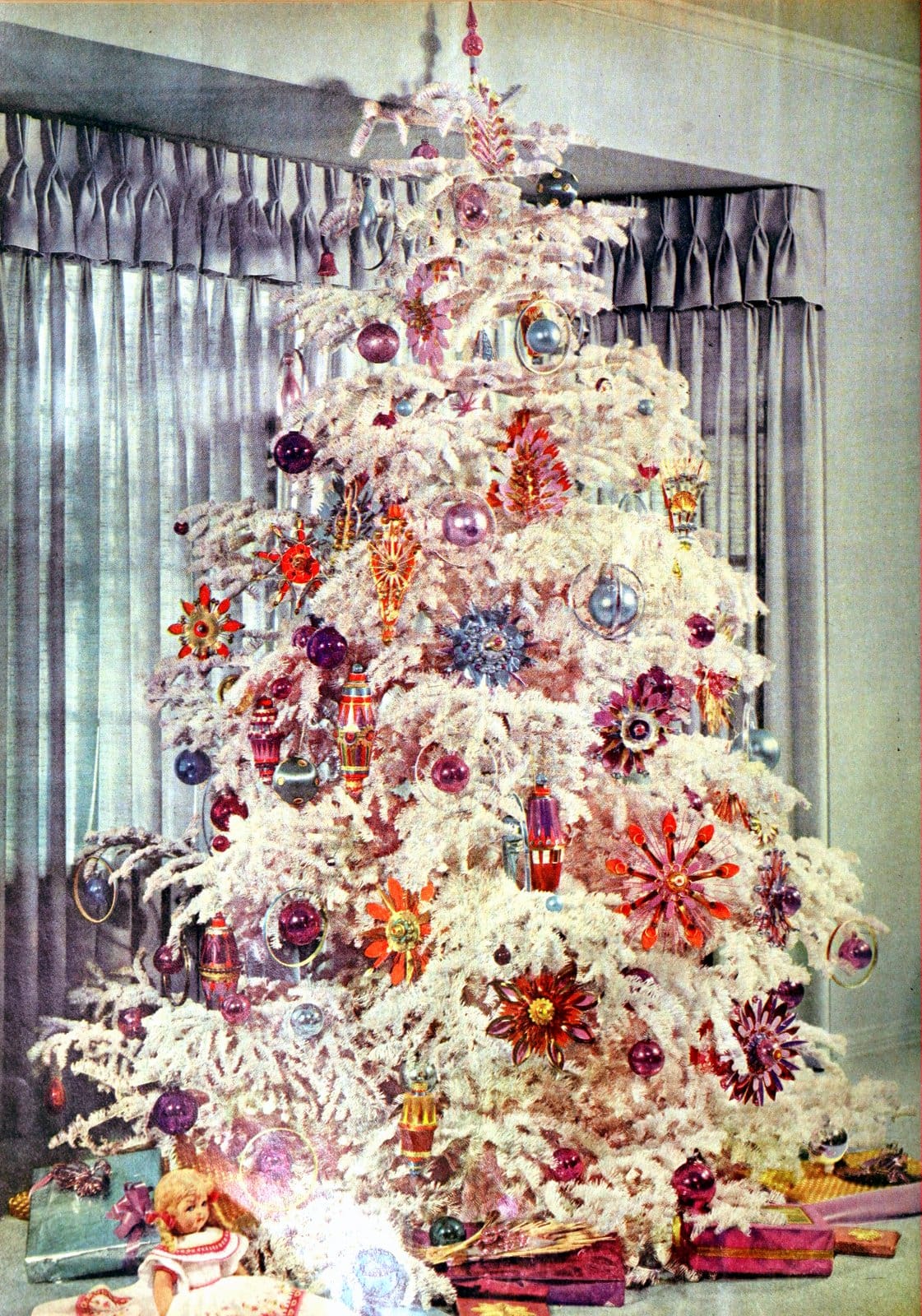
Image via Click Americana
An Australian Christmas is not an American postcard
Those American histories are interesting, but they are not a substitute for our own.
In Australia, snowy imagery sits alongside summer light. A ceramic snowman can look perfectly at home on a sideboard while the windows are open and the garden is baking outside. We do not need to resolve the contradiction. It is part of the fun.
Nor does an Australian Kitschmas need an imported checklist of aluminium trees, particular American ornament brands or a perfectly recreated 1950s living room.
It can begin with what you already have: a family ornament, a festive serving dish, a handful of colourful decorations or a small figure with an expression you find irresistible.
Your Christmas should belong to your home, not somebody else’s photograph. Painting pine cones from our front yard was a favourite Christmas activity growing up. We covered ours in glitter and white paint to mimic snow and somehow they remained quintessentially Australian in flavour.

Why the old decorations stay with us
Opening the Christmas box can feel different from unpacking any other household object. These are things we see briefly, put away carefully and meet again a year later.
Research discussed by psychologists Tim Wildschut, Constantine Sedikides and Clay Routledge describes nostalgia as an emotion often centred on relationships and shared experiences. It can contain sadness as well as pleasure. That feels more honest than treating Christmas memories as uniformly happy.
An ornament may remind you of someone you miss. Another may belong to a tradition you have made for yourself.
And you do not need to have grown up with a piece to love it. Sometimes an old decoration catches your eye because of its colour, its expression or its sheer audacity. You bring it home, and its next chapter begins.
How to bring Kitschmas home without buying a whole new Christmas
Start with a small scene
A sideboard, shelf or corner of the dining table is enough. Group a few figures together, add a little sparkle and leave enough space for their shapes and faces to be appreciated.
This is especially useful if your tree is already full, or you would rather keep fragile ornaments somewhere they can be admired without being knocked.
Give one unexpected piece the starring role
A pink flamingo among more traditional decorations offers a lovely moment of surprise. You do not need twenty novelty ornaments to make the point.
Choose the piece that makes you smile, then let the rest of the arrangement support it.
Repeat a colour, not an entire matching set
Pink in an ornament might pick up a ribbon or a floral plate. Green glass can sit happily beside festive greenery. Repeating a colour gives mixed pieces a little visual connection without making everything uniform.
Let the table join in
Christmas decorating need not stop at the tree. A festive dish, playful table ornament or colourful vintage glassware can bring character to the place where people actually gather.
Keep decorative pieces clear of serving space, and check that anything used for food is intended for that purpose.
Keep what you genuinely love
Kitschmas is not a requirement to buy more. Bring out your favourites first. If you add something, choose a piece you can imagine enjoying next year, not just one that suits this year’s mood board.

Buying vintage Christmas decorations thoughtfully
Look beyond the cheerful face and check the condition. With glass ornaments, examine the hanging point and any disclosed chips or cracks. With ceramic figures, pay attention to delicate projecting details and evidence of repairs.
Faded colour or gentle surface wear may be part of a piece’s appeal, but damage should still be described honestly. “Vintage charm” is not a substitute for a condition report.
It is also worth distinguishing vintage from retro-style. Both can be enjoyable; they simply tell different stories. A recent decoration with an old-fashioned design should not need an invented age to earn its place.
And an old electrical decoration is not automatically ready to plug in. Have it checked by a qualified professional before use.
A Christmas with character
Among the pieces I have been gathering for this year’s Christmas Shop are playful little figures and pink bird ornaments. They offer something different from the more traditional festive china, and I like that they can share the same Christmas.
There is room for elegance. There is room for silliness. There is certainly room for the ornament that makes absolutely no sense but comes out every year anyway.
That is the kind of Kitschmas I can get behind: not a new set of decorating rules, but permission to enjoy the things you love.
Explore The Christmas Shop for festive pieces to bring out, enjoy and make part of your own traditions.
References and further reading
The Henry Ford: From Light Bulbs to Christmas Baubles
Wisconsin Historical Museum: Ever Gleaming
British Psychological Society: Nostalgia, from cowbells to the meaning of life
Encyclopedia.com: Kitsch