


True luxury in vintage porcelain is often found in the work rather than the ornament alone. Here, an open lattice border transforms a serving bowl into something architectural, preserving the evidence of skilled making that mass-produced tableware simply cannot imitate.
This Meissen hard-paste porcelain bowl carries the celebrated Blue Onion design in underglaze cobalt, framed by a deeply pierced and interlaced rim. It is a considered centrepiece for a dining table or cabinet, equally striking displayed empty or used for dry serving on a special occasion.
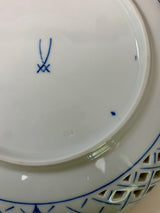
The underside bears Meissen’s underglaze blue crossed-swords mark with two horizontal cancellation strokes through its lower section, consistent with factory-second grading. The impressed form number appears to read 333. The grading is part of the bowl’s manufacturing history; no specific factory defect has been identified, and the delicate lattice presents exceptionally well.
Details
- Maker: Meissen
- Pattern: Blue Onion / Zwiebelmuster
- Form number: 333, impressed
- Era: 20th century
- Grade: Factory second, indicated by two cancellation strokes through the crossed-swords mark
- Form: Pierced / reticulated serving or cabinet bowl
- Diameter: 21 cm
- Height: 4 cm
- Footring: 12 cm diameter
- Weight: 460 g
- Material: Hard-paste porcelain with underglaze cobalt decoration
- Country of origin: Germany
Condition
Excellent vintage condition. The delicate reticulated border has been carefully examined, with no chips, cracks, broken lattice sections or restorations noted. The underside bears the crossed-swords mark with two factory cancellation strokes. No significant staining or surface damage has been noted.
The photographs form part of the condition report — please review all images carefully before purchasing.
Care
Hand wash only in lukewarm water using a soft cloth and mild detergent. Support the bowl from beneath rather than lifting it by the pierced rim. Do not soak, place in a dishwasher or expose it to sudden temperature changes.
Postage
Free tracked postage within Australia is included. This piece will be meticulously wrapped and double-boxed for protection, with postal insurance included for added peace of mind.
Age of an Item
Antique: An item that is at least 100 years old.
Vintage: An item that is at least 20 years old but less than 100 years old and is representative of its era.
Retro: A newer item designed in the style of a past era. It is not from that era but is a modern homage to it.
Condition of an Item
Mint: As new, with no signs of wear.
Excellent Vintage Condition (EVC): Shows minimal signs of wear through use but is not perfect.
Very Good Vintage Condition (VGVC): Shows some signs of age and use but is still in good overall shape.
Good Vintage Condition (GVC): Shows clear signs of wear, use, and age.
Perfectly Imperfect: This is not an official term. We've adopted it for the purposes of The Timeless Edit because we believe damaged items still have value. Our definition of Perfectly Imperfect is an item that has visible damage but remains beautiful as a decorative piece or suitable for use in a different capacity from that for which it was originally designed.
Common Flaws Found in Antique and Vintage Items
Air Bubbles: Air bubbles in hand-blown glass are a natural result of the traditional glassmaking process, where air becomes trapped in the molten glass during its creation. They are often seen as a sign of authenticity, indicating the item is handmade and unique, rather than a defect. While a small number of bubbles is generally acceptable, a high concentration of bubbles may indicate fragility. In some cases, air bubbles are an intentional decorative feature. Air bubbles are also found in Depression Glass due to its mass production method, where glass was quickly moulded with little concern for perfection — these bubbles are a common characteristic that signifies authentic pieces.
Bottom Wear: Common in older items, especially glass, and often an indication of age. Wear to the base of an item is caused by everyday use over time and includes scratches, scuffs, shallow chips, flakes, and flea bites.
Chip: Chips are considered either shallow or deep. A shallow chip is typically inconspicuous. A deep chip is large enough to be immediately apparent.
Crazing: Crazing is a web of fine cracks that occurs only in the glaze layer of fine bone china and porcelain. It is a normal occurrence, particularly in older items.
- Clean Crazing: The cracks are clear, without any staining from food, moisture, or other contaminants. Clean crazing can be used as an intentional decorative design element.
- Stained Crazing: This occurs when food particles, bacteria, or other contaminants get into the cracks over time, causing them to darken and become visually conspicuous. Items with stained crazing are not recommended for use with food but are still suitable as decorative pieces.
Firing Flaw: An original flaw caused during the firing process. Examples include pinholes or blisters in the glaze, grit stuck to the glaze, stains caused by an impurity in the porcelain, and shrinkage cracks that have opened during the drying or firing process. This is not considered damage.
Flake: A small and shallow chip which breaks the surface of an item.
Flea Bite: A tiny, pin-sized chip or nick in the surface of an item. It is a common form of imperfection in older items, especially glass.
Hairline Crack: A narrow and tight break going through the glaze and porcelain body, visible from both sides of the item. It is not always immediately obvious and can be missed on first inspection. Generally, a hairline crack does not affect the integrity of the item.
Maker's Miss: An unintentional inclusion or air bubble in the item caused or overlooked by the glassblower or maker during the manufacturing process.
Scratch: A mark which compromises the surface of an item and which feels raised, rough, or sharp to the touch. Not to be confused with Straw Marks and marks which can occur during the manufacturing process.
Straw Marks: Marks on the external surface of glass that look like fine lines or even scratches. They occur when molten glass is cut with shears and the resulting mark doesn't fully smooth out before the glass cools and sets. They are not considered damage but are instead a common characteristic of old, handmade, or machine-pressed glass. Unlike a scratch, straw marks feel smooth to the touch. Straw marks are commonly found in Depression and Carnival Glass.
Water Mark / Stain: Patches, ridges, deposits, and clouding on glass caused by water left standing in the vessel for a lengthy period. Such stains cannot be removed.
Materials and Techniques
Backstamp: The maker's mark printed or impressed on the base of a ceramic or glass item. Backstamps typically include the manufacturer's name, country of origin, pattern name, and sometimes a date code. They are the primary tool for authenticating and dating vintage pieces, and their design often evolved over a maker's history, allowing collectors to pinpoint when a piece was produced.
Bone China: A type of porcelain developed in England in the late eighteenth century, distinguished by the inclusion of bone ash (calcined animal bone) in the clay body. Bone ash gives bone china its characteristic creamy translucency, warmth, and exceptional strength relative to its delicacy. When held to the light, genuine bone china glows. It is the material of choice for the great English china makers — Royal Albert, Royal Doulton, Shelley, Coalport, and many others.
Gilding / Gold Trim: The application of gold to the surface of ceramic or glass as a decorative finish. On vintage pieces, gilding was typically applied using real gold — most commonly 22-carat gold — either by hand or by transfer, then fired to fuse it permanently to the surface. The quality and condition of gilding is an important factor in assessing a piece; worn or rubbed gilding is a common sign of heavy use.
Hand-painted vs Transfer Print: Hand-painted decoration is applied directly to the ceramic surface by an artist, making each piece subtly unique. Transfer printing involves applying a pre-printed design to the surface, allowing for consistent, repeatable patterns at scale. Many pieces combine both techniques — a transfer-printed ground with hand-painted highlights or gilding added over the top. Both methods are found across the great ceramics houses and each has its own collectible appeal.
Iridescence / Carnival Glass: An iridescent surface effect on glass, achieved by spraying metallic salts onto the surface of hot glass before it cools. The result is a lustrous, rainbow-like sheen that shifts colour in different lights. Carnival Glass — so named because it was commonly given as prizes at fairgrounds in the early twentieth century — is the most widely collected form of iridescent glass, produced in the United States, England, and Australia from around 1908 onwards.
Opalescent Glass: Glass that appears milky or translucent white in direct light but takes on a blue or lavender glow when backlit. The effect is achieved by adding bone ash or other opacifying agents to the glass batch. Opalescent glass is closely associated with the Art Nouveau movement and is a signature technique of René Lalique, whose pieces are among the most sought-after examples of the form.
Porcelain: A ceramic material fired at very high temperatures, resulting in a hard, dense, non-porous body. Unlike bone china, traditional porcelain does not contain bone ash. Hard-paste porcelain — the original European formula, developed in the early eighteenth century — is the material of Meissen, Sèvres, and Royal Copenhagen. Soft-paste porcelain, an earlier European approximation, has a slightly different texture and translucency. Both are distinct from bone china, though all three are commonly referred to as "china" in everyday use.
Few names in porcelain carry the authority of Meissen. Established in Saxony in 1710 under the patronage of Augustus the Strong, the manufactory became the first in Europe to produce true hard-paste porcelain successfully. That achievement ended Europe’s long dependence on imported Asian porcelain and helped create an entirely new chapter in European design.
More than three centuries later, Meissen remains a benchmark for porcelain manufacture. Its importance does not rest on age alone. It comes from the combination of material knowledge, modelling, painting, firing and hand-finishing required to turn an unforgiving material into objects of remarkable precision and character.
From royal experiment to design powerhouse
Early Meissen production was closely connected with the Saxon court, where porcelain served as art, spectacle and a demonstration of technical ambition. The manufactory soon developed a visual language of its own, moving beyond imitation to create European table services, sculptural figures, animals, flowers, decorative vessels and ambitious display pieces.
Meissen’s history includes changing tastes, artistic directors and generations of specialist craftspeople. Baroque exuberance, Rococo modelling, naturalistic flowers, neoclassical restraint and later historic revivals can all be found within its output. That range is part of the fascination: “Meissen” does not describe one look, but a continuing tradition of porcelain design.
Craftsmanship in porcelain
True hard-paste porcelain demands control at every stage. Clay bodies shrink during drying and firing; handles, pierced borders and sculptural details can warp or crack; underglaze and enamel colours respond differently to heat. Complex pieces may pass through many skilled hands before completion.
Look closely and the work becomes visible. Reticulated borders are cut before firing. Applied flowers are modelled petal by petal. Figurative groups depend on confident sculpting and careful assembly. Painted decoration requires both precision and an understanding of how colour will change in the kiln. These are not incidental flourishes. They are the substance of the object.
The crossed swords
Meissen’s underglaze blue crossed-swords mark is among the most recognisable porcelain marks in the world. Introduced in the eighteenth century and altered subtly over time, it remains an important starting point for identification.
The mark should never be treated as the entire story. Form, porcelain quality, decoration, impressed model numbers, painter’s marks and manufacturing details all contribute to attribution and dating. Because Meissen has been admired and copied for centuries, careful examination matters.
Blue Onion and Meissen’s decorative legacy
Introduced in the eighteenth century, Blue Onion, or Zwiebelmuster, became one of Meissen’s most enduring underglaze-blue designs. Its stylised flowering and fruiting motifs draw on East Asian decorative sources, despite the familiar English name.
The pattern’s extraordinary success led to versions by many other European, English and international manufacturers. That influence speaks to Meissen’s reach, but it also means that not every blue-and-white piece, or even every Blue Onion pattern, is Meissen. Genuine attribution depends on the object as a whole.
Beyond the dining table
Meissen may be encountered as plates, bowls and elaborate services, but its importance extends much further. Cabinet cups, pierced baskets, vases, covered vessels, candlesticks, animal models and figurative sculpture all form part of the manufactory’s legacy. Some pieces were made for use, others for display, and many occupy the delicious territory between the two.
In an Australian home, Meissen brings a different note from the English tableware that filled so many family cupboards. It belongs to a Continental tradition of courtly porcelain, yet a single bowl or figure can feel surprisingly modern when given space. It does not need a matching suite to justify itself.
Why collectors value Meissen
Value is shaped by more than the famous name. Age, rarity, model, decorator, complexity, condition, provenance and the quality of the individual example all matter. Delicate applied work and reticulation are especially vulnerable, so intact survival carries weight. Restoration, even when expertly done, should be disclosed.
Factory grading marks are also part of informed collecting. Cancellation or grinding marks through the crossed swords generally indicate that a piece was not released as first quality. That does not make it an imitation or erase the workmanship involved. A well-preserved factory second is still Meissen porcelain, though its grade should be stated honestly and reflected in the price.
Collecting with confidence
The best approach is to look slowly. Examine the mark, model numbers, porcelain body, decoration and condition together. On sculptural and pierced pieces, inspect every projecting detail and opening under good light. Buy the quality you can see, ask what has been restored, and be wary of dramatic claims built on a mark alone.
Meissen endures because it represents far more than prestige. It is the story of a technical breakthrough becoming a living decorative art, sustained by generations of makers. The crossed swords may draw the eye first, but the material, imagination and human skill behind them are what make the porcelain worth keeping.


