


Jacqui Fink
Enmeshed III: There Were No Clear Edges Between Us
What appears distinct remains tethered.
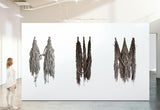
Hand-worked textile soft sculpture
An exploration of connection, proximity and the spaces where distinctions begin to blur.
Suspended forms are linked through an intricate network of bindings that move throughout the composition, creating a visual language of relationship, tension and exchange. Neither wholly separate nor fully unified, the work considers the ways proximity can transform our understanding of self and other. Individual elements remain present, yet are continually influenced by the structures that connect them.
Through repetition, tension and connection, it reflects the complex structures that emerge when individual experiences become inextricably linked. What appears distinct remains tethered; what seems independent is revealed to exist in relation to something beyond itself.
Enmeshed is a four-work series exploring the invisible structures that form between people under sustained emotional pressure — the bindings of care, burden, proximity and need that reshape individual identity over time. Each work stands alone as a complete statement; together, they form a meditation on what it means to remain distinct while becoming inextricably part of something larger than oneself.
This work is Part III of a four-work series. Enquiries regarding acquisition of the complete series are welcome.
Composition:
100% felted merino wool, cotton thread, timber dowel.
Dimensions:
50cm wide x 14cm deep x 170cm high
Year:
2026
Weight:
2.7kgs
Frame:
Unframed. The work is arranged on a piece of painted timber dowel, ready to hang.
Each work in the Enmeshed series is supplied with custom-made, powder-coated hanging brackets — designed specifically to hold the artwork away from the wall, allowing the woollen fibres to hang freely and naturally.
This work is supplied with a Certificate of Authenticity.
You can read more about the personal story that inspired this artwork in the Artist's Notes: Enmeshed Series.
You can read the Exhibition Statement for Cartography of Survival here.
I am a contemporary textile artist whose practice explores the relationship between material, emotion and adaptation. Working primarily with wool through processes of knitting, knotting, binding, stitching and construction, I create sculptural textile forms that investigate the ways people respond to experiences that challenge their sense of stability, identity and belonging.
My work is deeply informed by the repetitive nature of making. Through accumulation, labour and sustained engagement with materials, I explore how physical processes can become vehicles for reflection, endurance and transformation. Many of the forms that emerge in my practice begin intuitively, revealing their meaning only over time. As a result, making often functions as a form of inquiry—allowing ideas, emotions and experiences to take shape before they can be fully understood in language.
While the work frequently draws upon personal experience, it is not concerned with autobiography alone. Instead, I use material processes to investigate broader questions about care, resilience, vulnerability, connection and repair. The resulting forms occupy a space between abstraction and embodiment, suggesting emotional states, relationships and psychological landscapes without prescribing a singular interpretation.
At the centre of my practice is a belief in the capacity of making to hold complexity. Through textile processes that are both physically demanding and deeply repetitive, I seek to create works that acknowledge contradiction, endurance and the ongoing nature of adaptation. Rather than offering resolution, the work invites contemplation of the ways people continue to carry, rebuild and respond to the challenges that shape their lives.
Care
The Natural Resilience of Wool as an Interior Application
Your Jac Fink Original is handcrafted from premium merino wool, a fibre with remarkable natural longevity. Due to the inherent structure of the wool fibres and a high natural lanolin content, the fibres inherently repel dirt, dust and stains. As a result, these pieces require very little active maintenance. Wool is also a naturally fire retardant material.
Routine Dusting & Cleaning
The frequency of dusting and cleaning your artwork will ultimately be governed by the environment in which the artwork is hung. Routine dusting is advised to prevent the build up of dust and dirt, as both may, if not managed, discolour the wool over time.
To remove any settled dust or environmental particles, the artwork can be gently vacuumed. No specialised brush is needed — in fact, it is best not to use any attachments. The open, bare end of the vacuum nozzle or wand is ideal, as anything abrasive applied to the artwork may cause pilling.
Before starting, ensure the open nozzle of the vacuum is clean. Then gently run the nozzle along the woollen fibres. For stubborn areas, press the nozzle down on the affected area until the particles are removed. Work in gentle, smooth passes from the top of the hanging downward.
Standard Spot Cleaning
If required, spot clean any affected area by applying a small amount of wool wash on a smooth damp cloth and dabbing the affected area until the mark lifts. Lukewarm water is best. Avoid rubbing the area, as friction may cause pilling. Dab away any leftover soap residue with a fresh section of the damp cloth, then pat the area dry with a soft absorbent towel to remove any excess moisture. Allow to air dry.
Stain Removal
For any accidental liquid spills, such as red wine or coffee, the quick and generous application of soda water is generally effective. The effervescence helps lift the pigment out of the fibres before it sets. Use a soft dry cloth to press and absorb the liquid. Avoid rubbing the area. Always avoid rubbing or scrubbing the wool, as friction may cause the fibres to pill. If any shadow of the stain remains after the soda water dries, repeat the standard spot cleaning process as set out above.
Sunlight Exposure
Avoid hanging your textile artwork in areas that receive prolonged, intense, direct sunlight. Over time, UV rays can cause the wool to fade or change colour.
Humidity & Moisture
Whilst wool is highly resistant to mould, it is best to display your textile artwork in a dry, well-ventilated indoor environment. Avoid damp areas such as bathrooms or rooms with high humidity.
Avoid hanging the artwork directly against cold or exterior walls as condensation can trap moisture behind the artwork. Your textile artwork is best hung away from the wall to allow for proper airflow. Particularly in areas with high humidity, this will help prevent the build up of moisture between the wall and the artwork.
Storage
If you ever need to relocate, move or store the artwork for an extended period, protect it using these steps:
- Ensure the artwork is completely dry before packing.
- Lay the piece flat on a clean cotton cloth large enough to completely cover the artwork once wrapped. Gently roll the artwork with the cloth — or wrap if small — from one end to the other. It is important that the artwork is completely covered by the cloth and the cloth is secured in place. Do not use plastic wraps or airtight bags, as wool needs to breathe and plastic can trap moisture.
- Store the artwork in a cool, dry place. For long-term storage, place natural deterrents such as cedar balls or lavender sachets nearby to help protect the wool from moths and other insects.
Installation
Load Bearing
Your artwork can be hung from the ceiling or attached to a wall, subject to the load bearing capability of either area being appropriate. Each product listing specifies the hanging weight of the artwork. Please check this against the load bearing capacity of the relevant area in your home before hanging the artwork. Installation, and the safety of it, is the responsibility of the purchaser.
Hanging & Placement
Your Jac Fink Original is three-dimensional and highly textural in design. I recommend that the artwork be hung in a manner which allows it to hang away from the wall. This will give the artwork sufficient space to fall and rest naturally.
Each product listing provides information about the suggested hardware for hanging the respective artwork.


