


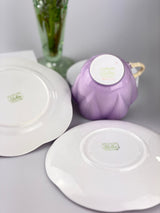
Exceptionally Rare Lilac and Butter Yellow Shelley Dainty
Discover this exceptional tea cup trio, an authentic vintage Shelley in an extremely rare colour combination. The trio, especially in this delectable hue of lilac with a contrasting handle in butter yellow, is a collector's item and exceptionally rare. The set's shape is known as the "Dainty" shape, which has a signature scalloped edge. The Dainty shape was a highly successful design that was in production from 1896 until 1966. Shelley is renowned for its fine bone china which is remarkably thin yet durable.
Why You'll Love It
- Shelley heritage - Renowned for remarkably thin yet durable fine bone china
- Dainty shape - Signature scalloped edge, in production 1896-1966
- Exceptionally rare colors - Lilac with contrasting butter yellow handle
- Collector's item - Extremely rare colour combination
- Very good vintage condition - No chips, cracks, crazing, or restoration
- Complete trio - Cup, saucer, and bread plate
- Highly sought-after - Shelley Dainty is beloved by collectors worldwide
Perfect For:
- Shelley collectors seeking rare Dainty pieces
- Thoughtful gifts for serious fine china collectors
- Anyone who appreciates exceptionally-rare vintage treasures
- Enhancing your cottage core aesthetic.
Condition Notes
This trio is in very-good vintage condition considering its age. No chips, cracks, crazing, or restoration. Minor surface wear to the saucer and bread plate through use. Please note that due to its date of manufacture, this item is no longer recommended for use. The glaze and hand-painted elements may contain lead.
The Details
Manufacturer: Shelley, England
Shape: Dainty (in production 1896-1966)
Age: Vintage
Condition: Very good vintage condition
Set includes: Cup, saucer, and bread plate
Weight: 335g
Material: Fine bone china
Care: Hand wash. For display purposes only.
Exceptionally rare lilac and butter yellow Shelley Dainty — this is a collector's dream!
Age of an Item
Antique: An item that is at least 100 years old.
Vintage: An item that is at least 20 years old but less than 100 years old and is representative of its era.
Retro: A newer item designed in the style of a past era. It is not from that era but is a modern homage to it.
Condition of an Item
Mint: As new, with no signs of wear.
Excellent Vintage Condition (EVC): Shows minimal signs of wear through use but is not perfect.
Very Good Vintage Condition (VGVC): Shows some signs of age and use but is still in good overall shape.
Good Vintage Condition (GVC): Shows clear signs of wear, use, and age.
Perfectly Imperfect: This is not an official term. We've adopted it for the purposes of The Timeless Edit because we believe damaged items still have value. Our definition of Perfectly Imperfect is if an item has visible damage but remains beautiful as a decorative piece or suitable for use in a different capacity from that for which it was originally designed.
Common Flaws found in Antique and Vintage Items
Crazing: Crazing is the existence of web of fine cracks that only occurs in the glaze layer of Fine Bone China and porcelain. It is a normal occurrence, particularly in older items.
- Clean Crazing: The cracks are clear, without any staining from food, moisture, or other contaminants. Clean crazing can be used as an intentional decorative design element.
- Stained Crazing: This occurs when food particles, bacteria, or other contaminants get into the cracks over time, causing them to darken and become visually conspicuous. Items with stained crazing are not recommended for use with food but are still great for use as a decorative piece or other practical function.
Flea Bite: A flea bite is a tiny, pin-sized chip or nick in the surface of an item. It is a common form of imperfection in older items, especially glass.
Bottom Wear: This is common in older items, especially glass, and is often an indication of age. Wear to the base of an item is caused by everyday use over time and includes scratches, scuffs, shallow chips, flakes, and flea bites.
Chip: chips are considered either shallow or deep. A shallow chip is typically inconspicuous. A deep chip is large enough to be immediately apparent.
Flake: a small and shallow chip which breaks the surface of an item.
Scratch: a mark which compromises the surface of an item, and which feels raised, rough or sharp to the touch. Not to be confused with Straw Marks and marks which can occur during the manufacturing process.
Hairline Crack. This is a narrow and tight break going through glaze and porcelain body and is visible from both sides of the item. It is not always immediately obvious and can be missed on first inspection. Generally, a hairline crack does not affect the integrity of the item.
Water Mark/Stain: patches, ridges, deposits and clouding on glass caused by water left standing in the vessel for a lengthy period. Such stains can’t be removed.
Air Bubbles: Air bubbles in hand-blown glass are a natural result of the traditional glassmaking process, where air becomes trapped in the molten glass during its creation. They are often seen as a sign of authenticity, indicating the item is handmade and unique, rather than a defect. While a small number of bubbles is generally acceptable, a high concentration of bubbles may indicate fragility. There are exceptions though. In some cases, air bubbles are an intentional decorative feature where artists have used specific Molds or techniques to control their appearance. Also, air bubbles are found in Depression Glass due to its mass production method, where the glass was quickly moulded with little concern for perfection. These bubbles are a common characteristic that signifies authentic pieces.
Maker’s Miss: This is an unintentional inclusion or air bubble in the item caused or overlooked by the glass blower or maker in the manufacturing process.
Firing Flaw: This is original flaw cased during the firing process. Examples include pinholes or blisters in the glaze, grit stuck to the glaze, stains caused by an impurity in the porcelain and shrinkage cracks that have opened during the drying or firing process. This is not considered damage.
Straw marks: These are marks on the external surface of glass that look like fine lines or even scratches. They occur when molten glass is cut with shears, and the resulting mark doesn't fully smooth out before the glass cools and sets. They are not considered damage but are instead a common characteristic of old, handmade, or machine-pressed glass. Unlike a scratch, straw marks feel smooth to the touch. Straw Marks are commonly found in Depression and Carnival Glass.


